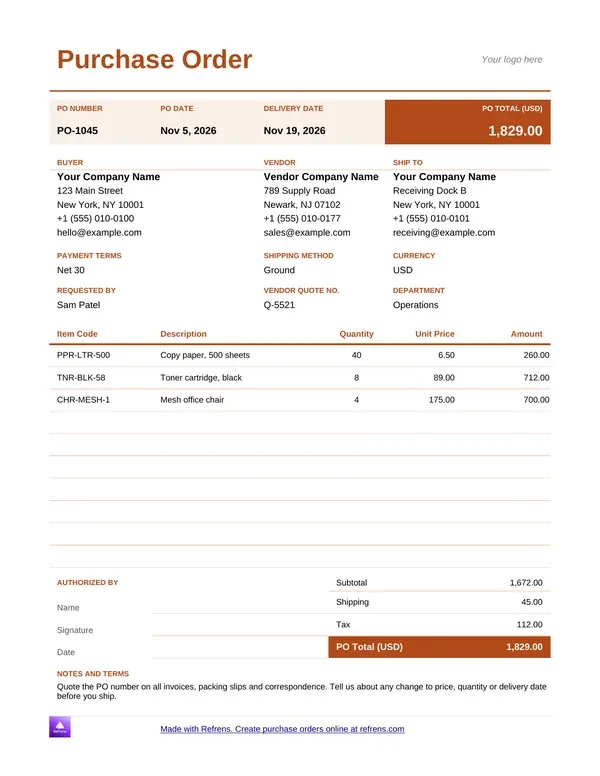
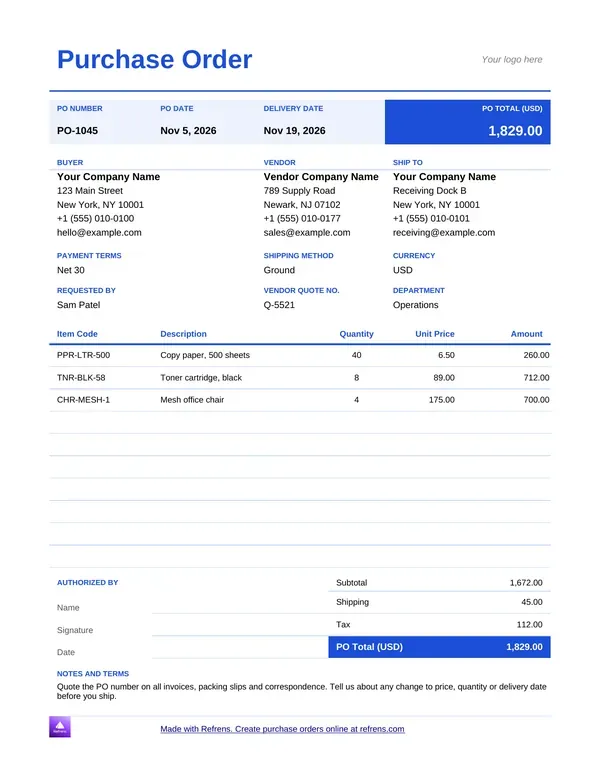
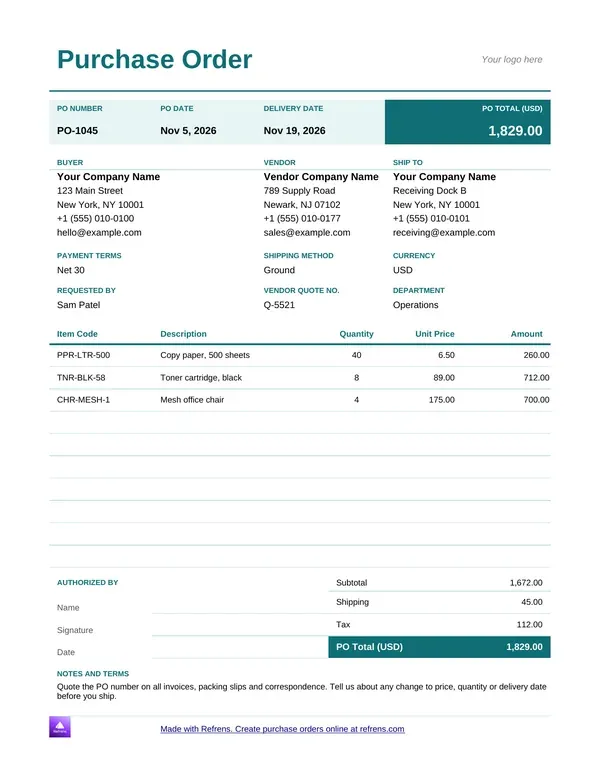
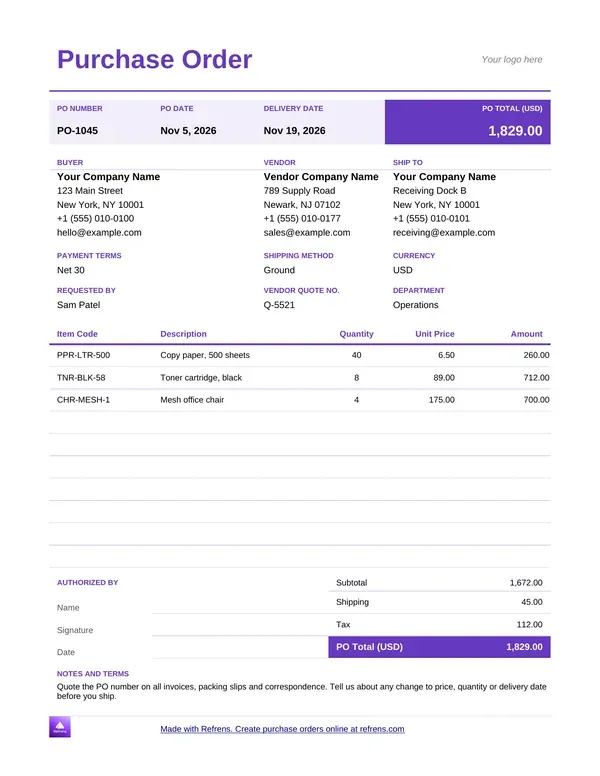
You need five laptops by Friday. Your supplier needs to know exactly what you want, at what price, and by when. Send a purchase order.
A purchase order (PO) is the buyer's document to a supplier. It lists the goods or services you want, the quantity, the agreed price and the delivery date. You send it before the supplier delivers. Once the supplier accepts it, it binds both sides. Then the supplier delivers and sends you a tax invoice.
A purchase order is not a tax invoice. It is your request. The tax invoice comes later, from the supplier.
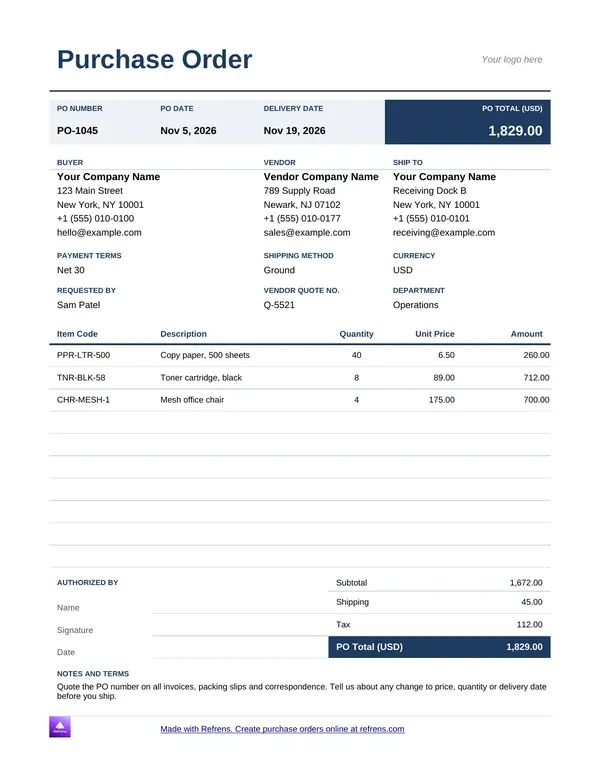
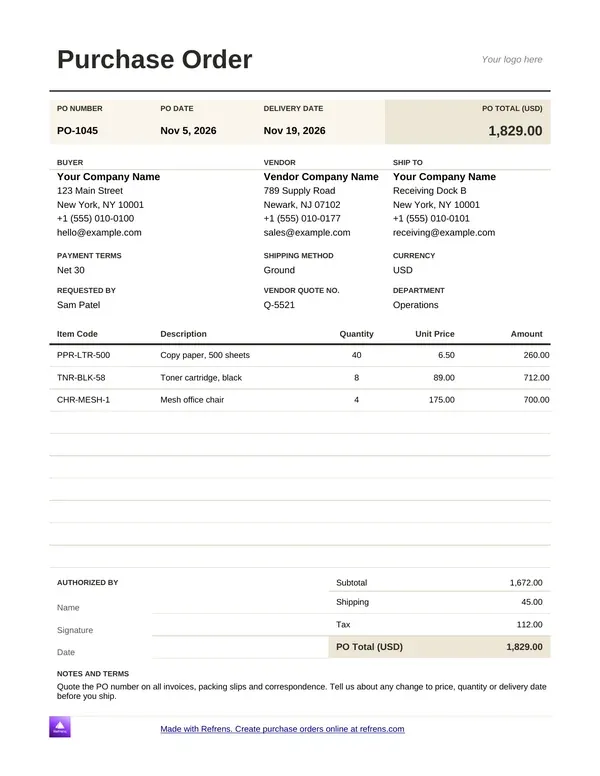
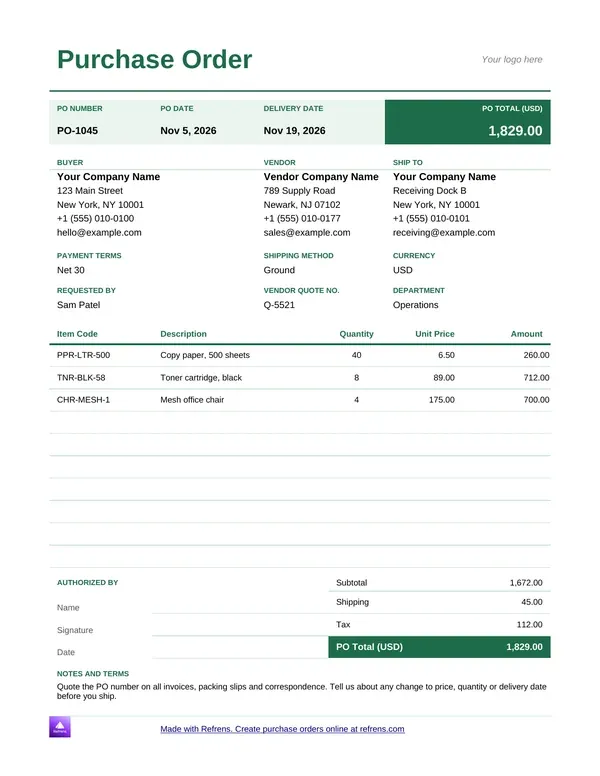
A purchase order template gives you the layout once. You change only the supplier, the items and the numbers. This page gives you four ways to make one:
All four use rand and a VAT line at 15%.
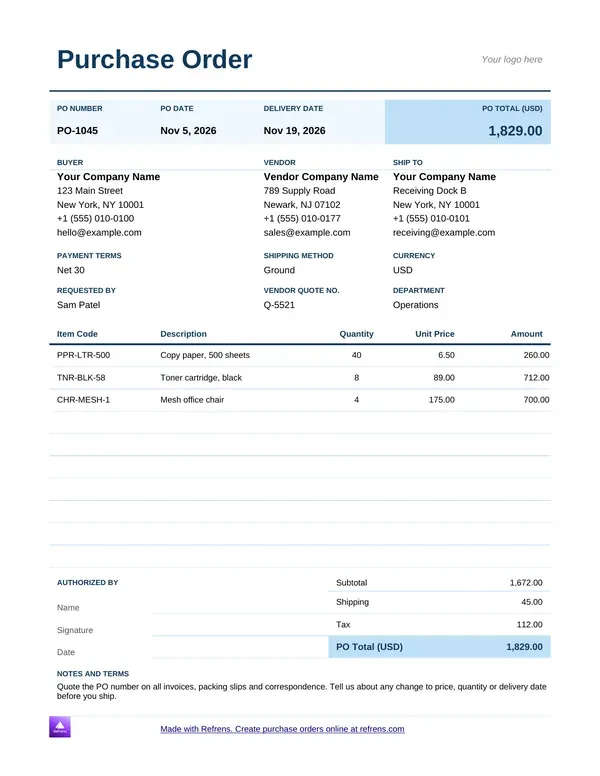
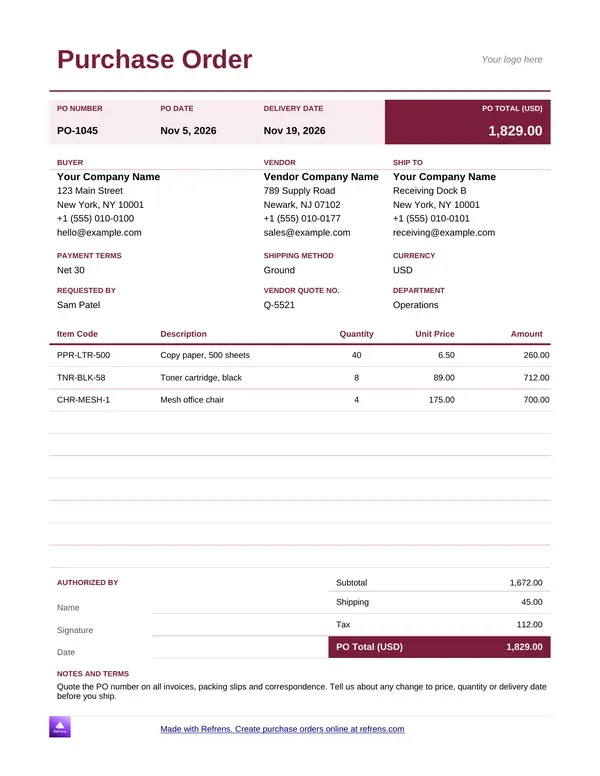
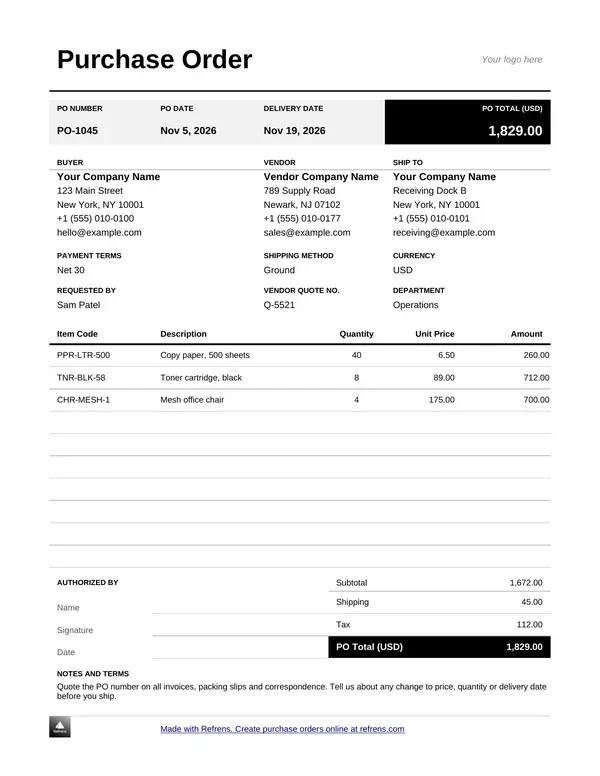
Not sure which file to pick? Word suits a short order with a few lines. Excel suits an order with many lines and a total that has to be right. Both save as PDF. Each template comes in several colours, so pick the one that suits your brand.
Each file has:
A purchase order is a short document. Word keeps it that way. Open the file, replace the sample text and send it.
Add your logo and your own terms. Nothing locks you out. You type the sums by hand in Word, so check each total before you send.
Excel does the arithmetic. It works out each line amount, the subtotal, the VAT and the PO total. Change a quantity and every figure moves.
Use it for stock and materials orders with many lines. Put the vendor's quote number on the order, so the supplier can match your order to their quote.
Every file is an editable purchase order template. Change the text, the columns, the logo, the terms and the layout. Reuse the file for the next order. Change the PO number and the delivery date every time.
Eight steps.
Skip the file. Use the purchase order generator in the form at the top of this page. You add the details. Refrens does the totals and the VAT, then gives you a PDF. Use it as a free purchase order maker. Generate a purchase order online without building a file.
You can fill in the form before you sign up. The free plan covers 15 documents a year.
The form has two steps. Step 1 holds the order itself: the PO number, the PO date and the delivery date, then Billed By and Billed To, your items and your total in rand. You can show the total in words and add a summary of the total quantity. You can also add terms and conditions, notes, attachments, a signature and your contact details. Step 2 is design and sharing. Pick a template, colours and a font, then download, print, email or share.
Email it. Add the supplier's email address and Refrens fills in the subject and the message for you. Edit either one. The supplier opens the order from a button in the email, or downloads it from there.
Here is an illustrative sample purchase order. An IT services firm in Sandton buys five laptops and a router from a supplier.
In Excel, with the items in rows 2 and 3, each amount is =B2*C2. The subtotal in D4 is =SUM(D2:D3). Shipping goes in D5. VAT in D6 is =(D4+D5)*0.15. The PO total in D7 is =D4+D5+D6.
Change a quantity in column B and every figure moves. The Excel template already holds these formulas.
Send a PDF. Keep the Word or Excel file as your working copy. A PDF keeps your layout and stops anyone changing your price.
Name the file with the PO number and the supplier, for example PO-0042-Supplier-Name.pdf. You will find it in seconds a year from now.
Every purchase order needs the same bones, whatever you buy.
Miss one and the supplier phones you. Or ships the wrong thing.
The cycle has eight steps.
Matching the three documents is good practice. It is not a legal rule. It catches a wrong price, a short delivery and a duplicate bill before you pay.
Three documents. Three different jobs.
The sequence runs quotation, purchase order, delivery, tax invoice. The purchase order ties the other two together. Quote its number on the invoice and you match the bill to the order in seconds.
VAT in South Africa is 15%. Show the VAT on your purchase order. You see the full cost before you commit.
A purchase order is not a tax invoice. The VAT becomes a charge on the supplier's tax invoice, when the supplier charges VAT. Keep the tax invoice. It is the document you keep for your records.
Give purchase orders a number series of their own, such as PO-0001. Do not share numbers with your quotes or invoices.
Does your supplier charge no VAT? Delete the VAT line.
You do not need a big company to need a purchase order. You need a supplier and a price to protect.
Skip it for tiny cash purchases. A PO adds a step. Use it when the amount, the supplier or the delivery date matters.
Each mistake sits next to the field that prevents it.
Check the six before you hit send. It takes a minute.
A file is a good start. It has limits.
Send a few orders a month? A file does the job. Send more, and every retyped line is another chance for a mistake. That is when Refrens pays for itself.
Change the layout to fit your order. Add custom columns and fields, and hide the ones you do not need. You do not retype the same details for every order.
Pick a template. Choose colours from your logo and change the heading font.
Email the order to your supplier with the subject and message filled in. Track every order from the purchase order dashboard.
Stop searching your computer for old orders. Manage and save every purchase order in one place, with your supplier's details beside it.
Turn a purchase order into an expense in one click. You do not build the expense from scratch.
Download a PDF, print it, share it by WhatsApp or copy a link. Duplicate an order in one click when you buy the same thing again.
Order in rand, or in the currency your supplier bills in.
Create a purchase order on Refrens for free.
Pick a purchase order template in Word or Excel above, or fill in the generator at the top of this page. Replace the sample text, check the VAT and send the order as a PDF. Word suits a short order. Excel suits one with many lines and a total that has to be right.
When the files start to slow you down, move your orders into Refrens. It calculates the VAT, keeps every order in one place, lets you track it and turns the order into an expense in one click. Start free.
A purchase order is the buyer's document to a supplier. It lists the goods or services you want, the quantity, the agreed price and the delivery date. You send it before the supplier delivers. It is not a tax invoice. The tax invoice comes from the supplier after delivery.
Yes. Choose the Word template on this page. It opens in Google Docs. Choose File, then Download, and pick Word (.docx). Replace the sample text with your details. You can edit anything: text, columns, logo and terms.
Right here. Choose the Excel template on this page. It opens in Google Sheets. Choose File, then Download, and pick Excel (.xlsx). The Excel file calculates each line amount, the subtotal, the VAT and the PO total.
In Word or Excel, choose File, Save As, then PDF. In Google Docs or Google Sheets, choose File, Download, then PDF. In the Refrens generator, download the PDF from the form. Set an Excel sheet to fit one page wide before you save.
Read the sample purchase order on this page. It shows five laptops and a router, with shipping, VAT at 15% and the PO total of R91,022.50. Every figure reconciles, so you can copy the method into your own order.
Add your logo, the PO number, the PO date and the delivery date. Fill in your details and your supplier's. List each item with its quantity and unit price. Add VAT at 15%, your payment terms and an authorised signature. Save it as a PDF and send it. Or use the generator at the top of this page and let Refrens do the totals.
Yes. Use the purchase order generator in the form at the top of this page. You can fill it in before you sign up. Downloading the PDF needs a free account. The free plan covers 15 documents a year.
Fill in the purchase order form at the top of this page. Add your supplier, your items and your VAT. Pick a template and your colours, save the order and download the PDF. You can also email it to the supplier or share it by WhatsApp.
A purchase order must include:
A purchase order is your order to the supplier, before delivery. An invoice is the supplier's bill, after delivery. In South Africa the supplier's bill is a tax invoice when the supplier charges VAT. Quote the PO number on the invoice so you can match the two.
A quotation is the supplier's offer. A purchase order is your order, placed after you pick a quote. The supplier quotes first. You order second. Put the vendor's quote number on your purchase order.
A purchase order is an offer to buy. Once the supplier accepts it, in writing or by starting the order, it binds both sides. Read your terms before you send one. Put the price, the quantity, the delivery date and the payment terms on the order.
Use a series of its own, such as PO-0001, PO-0002 and so on. Do not share numbers with your quotes or invoices. One number per order. Never reuse one.
Show the VAT on your purchase order so you see the full cost before you commit. Add VAT at 15% as its own line. The supplier charges the VAT on their tax invoice, when they charge VAT. If your supplier does not charge VAT, delete the VAT line.
Yes. Refrens stores your data with encryption and cloud protection. Refrens is ISO/IEC 27001:2022 certified.
The free plan covers 15 documents a year. Purchase orders count toward that limit, along with quotations, invoices and other documents.
Refrens is cloud invoicing and quotation software for small businesses, with a built-in sales CRM and inventory. Service industries such as agencies, consultants, IT businesses and T-KIBS (Technology- and Science-Based KIBS), along with contractors, wholesalers, traders and distributors, use it to quote, bill and keep records in one place. More than 6,300 South African businesses created quotations on Refrens, and more than 2,900 created invoices.